Minor spoilers for Buddy (2026)
As a kid growing up through the 90s and 2000s, I didn’t get shamed for liking TV shows that were “too young” for me. With one exception. Barney. Despite having pretty strong memories of the show, I have stronger memories of fervently denying that I liked it, and of the way people made fun of it, childish parodies of the songs. And weirdly, both sets of memories were viscerally brought back to me when I watched Buddy.
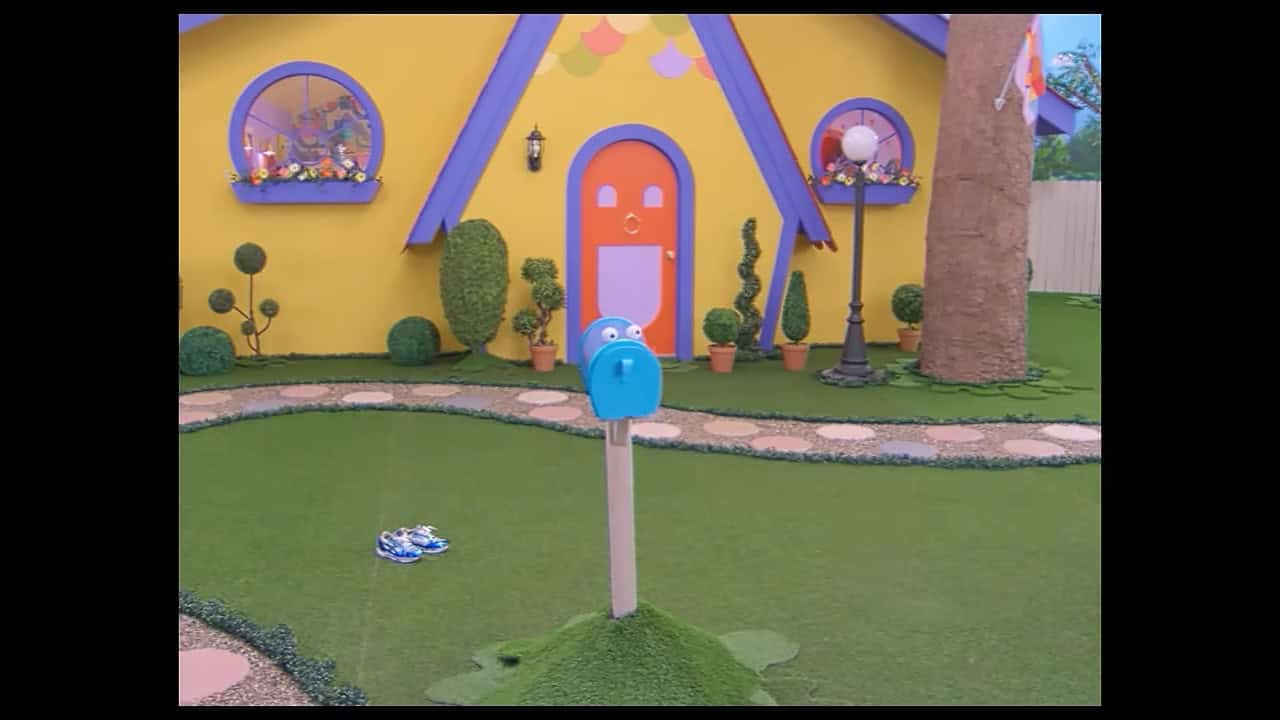
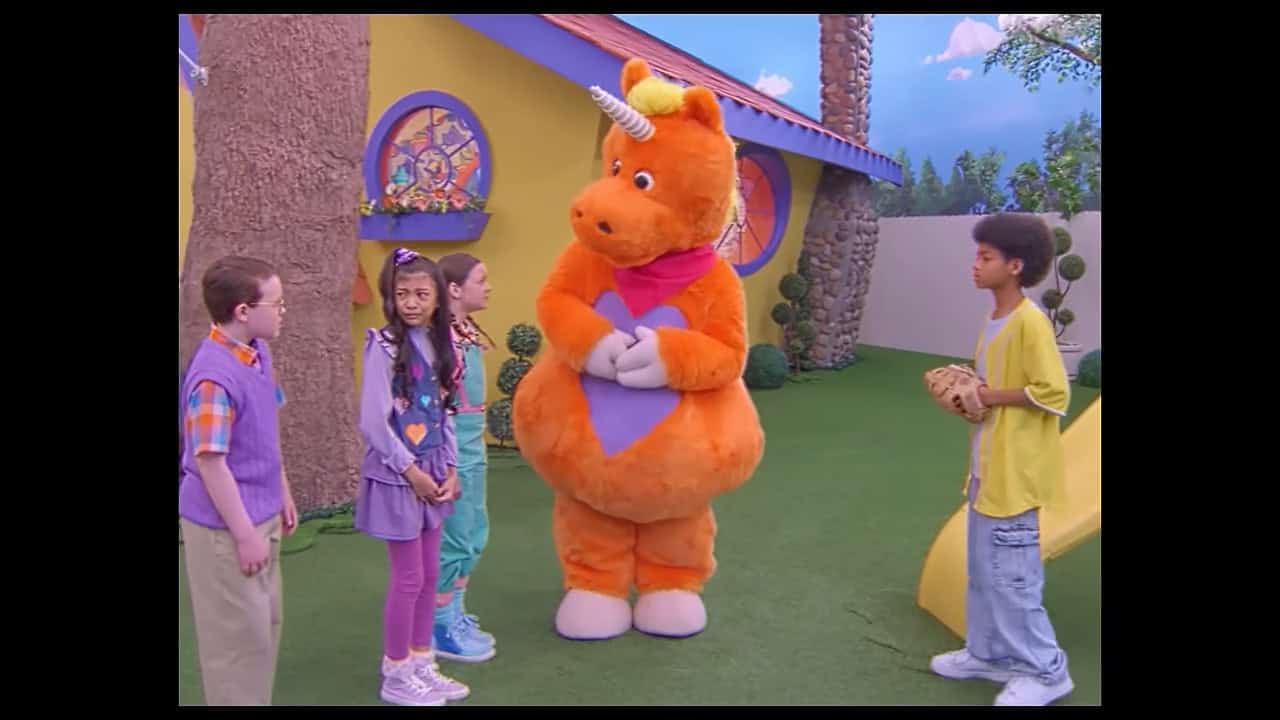
Directed and written by Casper Kelly, Buddy opens with a theme song that is a beat-for-beat recreation not just of a Barney intro, but has elements of many kids’ shows of the time: a set of “Look to Camera” credits, some clips featuring dances, crafts, and less-frequently featured puppets, ending in the It’s Buddy logo. And without missing a beat, we transition straight into an episode. The similarities continue to be uncanny: the crane-in around the treehouse before transitioning to a standard studio multi-cam setup (all shot in 4:3, for an extra shot of authenticity); the over-saturated colors in the set and the extremely 90s costuming; Buddy appearing as a small stuffed animal before magically becoming the costumed talking version when his name is called by the kids. The songs and even Keegan-Michael Key’s voice are all sitting right in the Uncanny Valley in similarity to Barney. There are other elements that are clearly pulled from different kids’ shows. The talking backpack, couch, mailbox, etc. are all more reminiscent of PeeWee’s Playhouse, while the clip segments showing examples of the show’s topic-of-the-day are similar to parts of Blue’s Clues, Elmo’s World, and Mister Rogers’ Neighborhood.
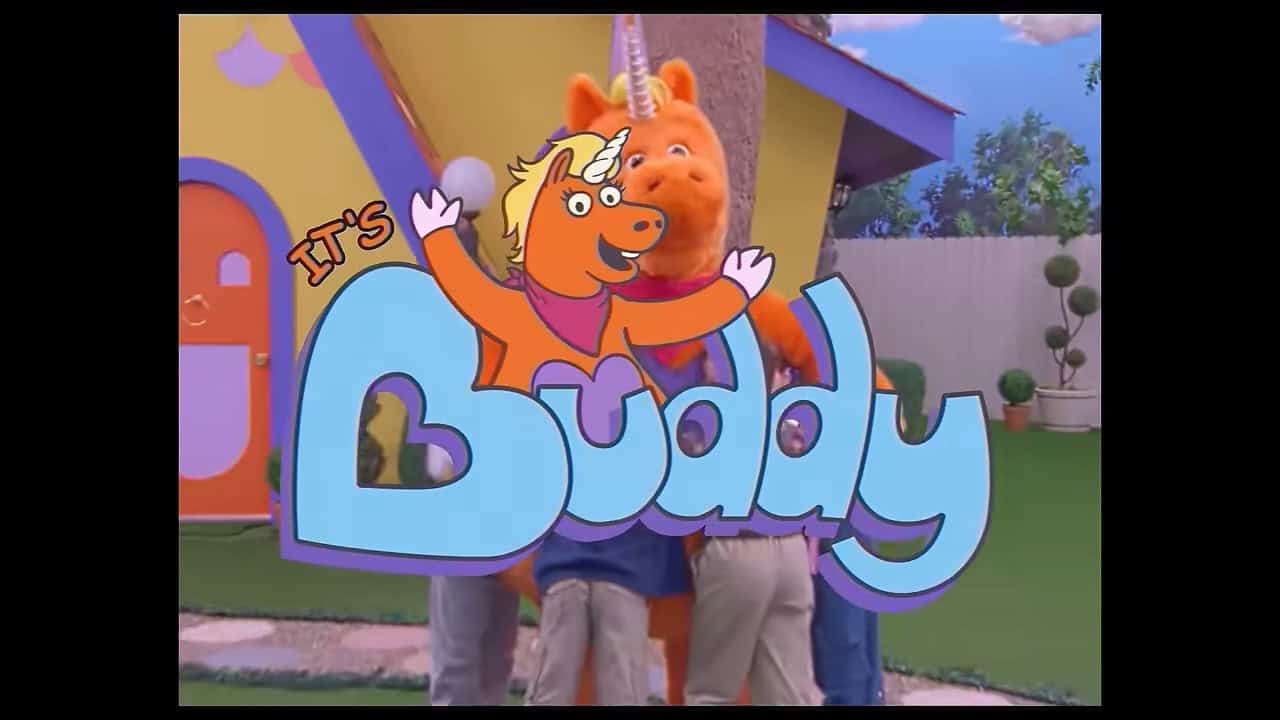
As the “episode” begins, two of the kids, Freddy and Wade, receive invitations to a dance party. However, Freddy is hesitant and admits that she’s nervous and a little afraid to dance in front of other people, worried she might not be any good at dancing. Wade and Freddy call on Buddy, who sings a song with the kids about how you have to be afraid before you can be brave, and during the song, Wade and Buddy show Freddy a couple of dance moves and make her feel better. The plot of the show seems pretty consistent with what any of those shows might try to teach kids: being scared is okay, and being brave means you can try something new, even if you feel afraid. With Keegan-Michael Key’s pitch-perfect voice acting, you could one-hundred percent mistake that you’ve walked into the wrong theater and are just watching some lost media kids’ show. Until another kid, Josh, refuses to dance, not because he’s scared, but because he just wants to keep reading his book. Buddy drags Josh just off camera where we can hear sounds of a struggle, as Mr. Mailbox looks on, apparently horrified but unable to move (since he’s, you know, a mailbox and doesn’t have legs).
At the dance party, Buddy tells the kids that Josh learned to dance and loved it so much, he left to go on tour in Diamond City. After this, the kids gather around and sing the closing song as the credits roll. The song is another eerie similarity: Barney had “I Love You, You Love Me”, and in the movie, it’s “You Love Buddy, Yes You Do”. “I Love You” is sung to the tune of “This Old Man” and “You Love Buddy” is sung to the tune of “Twinkle Twinkle Little Star”. But as Freddy is giving Buddy a hug and singing the song, she happens to glance down into the trash and sees Josh’s book. Splattered with blood. Another episode begins immediately, and one of the first things Freddy notices is that Mr. Mailbox’s door has been ripped off, leaving him unable to speak, just wiggling his eyes and his little red flag.
I feel like I need to state the following for anyone wondering if this movie is something they can handle: No actual harm to children is explicitly shown on screen beyond pushing, grabbing, being carried against their wishes, but a child’s body is partially obscured while it is implied they are being attacked with a knife, a child’s dead/dying body is momentarily held up like a puppet, and a handful of other scenes showing a child’s dead body. There is one brief and extremely uncomfortable instance where an adult man tells a little girl she has a pretty face. Know what you are and aren’t comfortable with! All of the child actors in the movie absolutely knock it out of the park; they come across as genuine kids in a scary situation, reacting in different ways and trying to rely on each other. Even when they’re delivering the cheesy lines of the episodes, it doesn’t come across as hammy or forced.
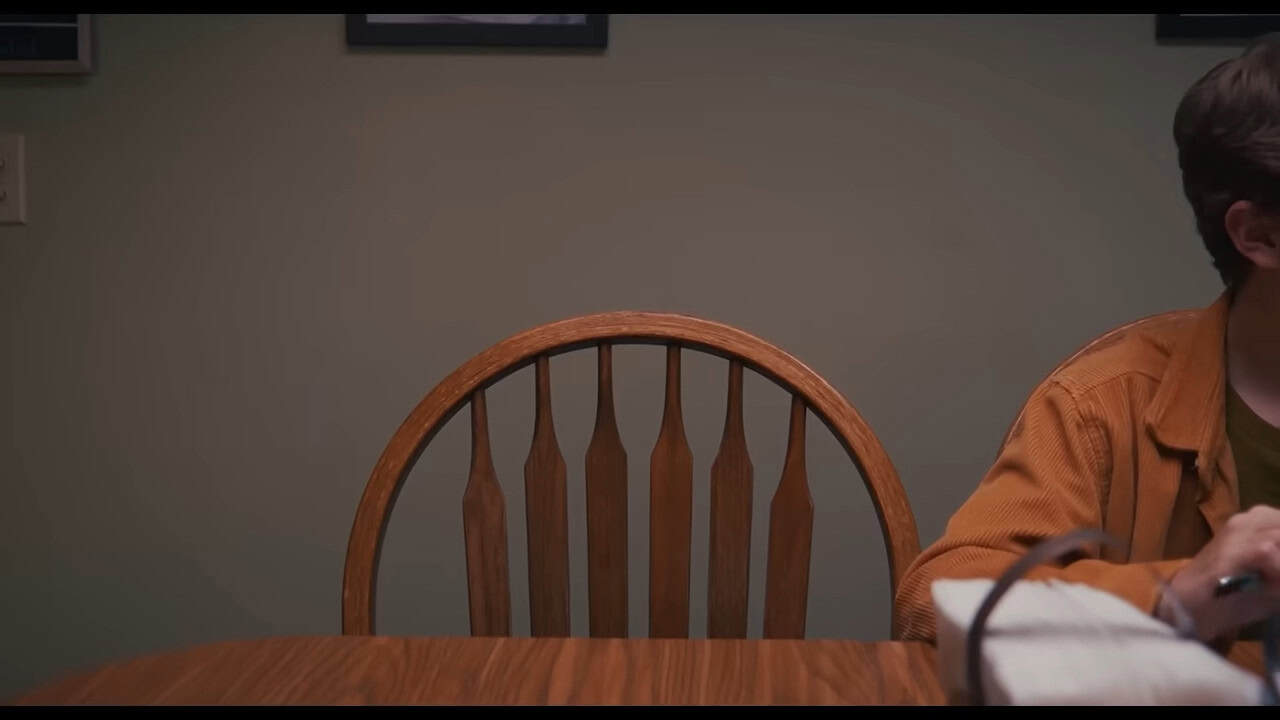
I feel that there will be an ongoing argument about whether this movie made optimal choices with regard to sequencing the story, but to me, it made sense and made me feel more grounded. All of the promotional material was enticing but gave very little away, and these separate acts gave me points to orient myself around. Anchor points. The episodes of It’s Buddy continue up to a certain point, and then we switch to the real world. We switch to Grace (Cristin Milioti), a working mom of two who just seems a little off. She reminisces about something with her oldest kid who has no memory of the event she’s referring to. She calls for everyone to come to dinner after everyone is already seated at the table. She stares blankly at the empty chair across from her and screams. Not everyone gets it right away. I didn’t; I thought she was one of the kids who had escaped, all grown up and having some kind of relapse. I was waiting for one of her kids to get taken so she would have to go back and face him. And then the camera lingered on the stick figure family on the back windshield of the SUV, and it clicked for me. She’s not one of the kids.
She’s one of their moms.
This movie is bleak at times. It confronts its child characters with some heavy, dangerous situations and does not give them any kind of plot armor or pull any punches. It is the first movie in a long time, and this is a major spoiler: that actually produces a final girl in the truest sense of the word. End spoiler. Yet the horror is not truly from the violence; there were more instances of laughter during a bloody dismemberment than gasps of horror.
Towards the end of the movie, Buddy uses a lot of coercive language, making the kids apologize for making Buddy feel bad by running away from him and threatening to isolate them if they don’t comply with what he wants. During the final confrontation, a character who had seemed oblivious to everything going on, Betty Bunny, suddenly has a lot to say:
“Say you’re sorry! Say you love him! Or we’ll all die!”
The origin of the horror is the powerlessness against an abuser and a system where they have absolute control. The horror is in being forced to smile and pretend that you agree everything is fine and nothing bad has happened to you.
The scene that actually scared me the most happened toward the end of the “real world” sequence with Grace. Major spoiler: As Grace has her hand halfway pulled through a portal in the television screen, partially caught by Buddy’s trap, she struggles up the stairs yelling for her husband Ben (Topher Grace) as she hauls the TV along with her, fighting to free herself. Ben, who has been skeptical of Grace’s suspicions and distress all along, doesn’t seem to be willing to look up from his phone. She stands at the foot of their bed, almost shoulder-deep into the portal; she begs her husband to look, asks if he can even hear her. And he gets up, walks out of the room, as if she’s not even there. As if her struggle wasn’t even happening, even though he was mere steps away. I think I’d rather get strangled, to be honest. End spoiler.
I could write a lot more about this movie, especially about the last ten minutes. Packed with little glimpses of things and basically dripping with lore-bait, a handful of stills from this section could probably fuel a whole series of YouTube videos, but Casper Kelly seems to have had a message that has nothing to do with theory-crafting. You have to be scared to be brave. There are things important enough for you to fight for that you can overcome your fear, your exhaustion, and even push back against people who are telling you that you’re wrong, so that you can do the brave thing.
FilmObserver Score: 9/10 – Outstanding
 ObserverCrew Picks
 bserver
 bserver